Gravitation
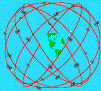
Orbits
Apogee
Perigee

Telescopes
Quadrants
Astrolabes
Magnetic compass
Solar system
1. Moon * and eclipses
2. Individual planets *
3. Meteroids *
4. Solar wind
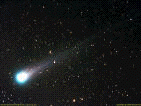
5. Comets *
6. Sun * and eclipses
7. Stars *
8. Satellites * and rings
orbits and motions (rotation, zodiac * )
seasons * and time zones (standard time and daylight savings time)
sunrise and sunset tables
tides

Mathematical geography
Positional astronomy *
latitude
longitude
map reading

Celestial navigation
Determination * of latitude and longitude
Applying * the use of latitude and longitude

Arithmetic and astronomical
solar and lunar calendars
Time * around the world
local times
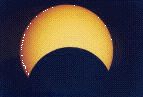
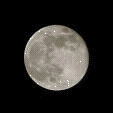 The Moon (Dewey 523.3)
 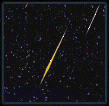 Meteoroids, solar wind, zodiacal light (Dewey 523.5)
  Sun and eclipses (Dewey 523.7)
 Stars (Dewey 523.8)
 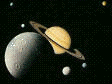 Satellites and rings, eclipses, transits, occultations (Dewey 523.9)
 [unassigned - Dewey 524]